Office Space Trends New York
New York office space trends are shaped by forces that extend far beyond simple rent levels. Companies evaluating Manhattan offices must understand how demand patterns, building quality, tenant expectations, and economic cycles influence where organizations choose to locate and how landlords structure leases.
In practice, the New York office market operates as a constantly adjusting system. As one segment strengthens, another softens. As a result, tenants who understand these shifts often secure stronger deals, better buildings, and more efficient layouts.
Therefore, this page explains the major office space trends shaping Manhattan today and what those trends mean for companies planning leases.
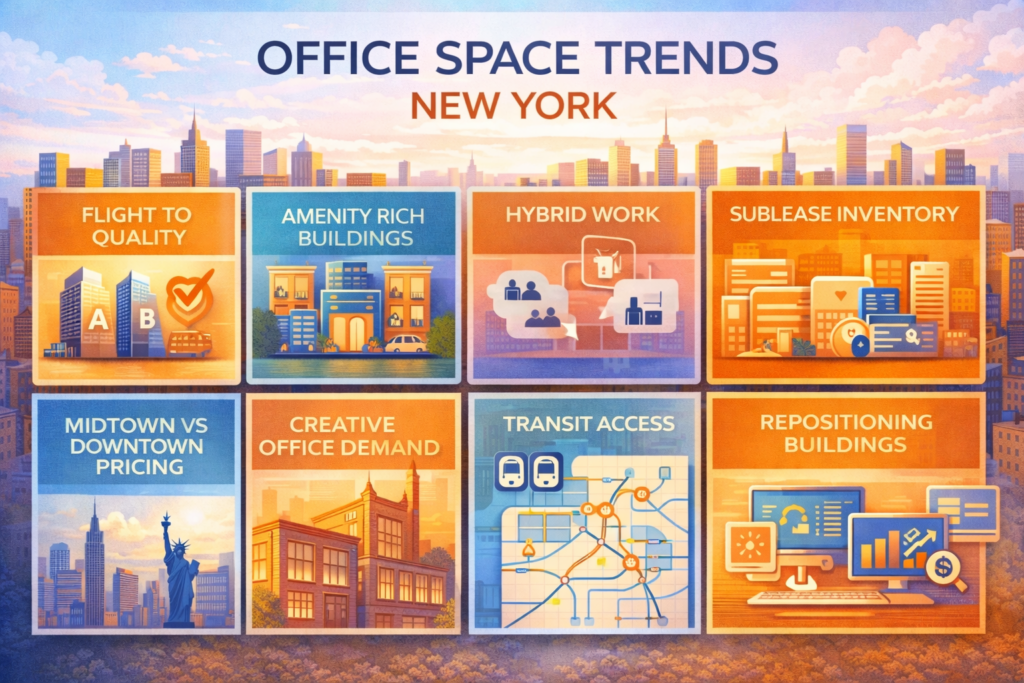
The Flight to Quality
One of the most visible trends in the New York office market is the flight to quality.
Companies across multiple industries have been relocating from older buildings into newer, amenity-rich towers. Notably, this movement does not always increase rent. In many cases, companies pay comparable or even lower effective rents due to landlord concessions.
However, the difference lies in the building itself.
Modern Class A towers increasingly offer:
• Tenant lounges
• Conference centers
• Fitness centers
• outdoor terraces
• hospitality-level lobbies
• advanced building systems
• flexible shared meeting space
As a result, the experience of working in the building becomes a competitive advantage for employers seeking to attract and retain staff.
At the same time, many older Class B buildings must reposition themselves through renovations, pricing discounts, or conversion strategies in order to remain competitive.
Amenity Competition Between Buildings
Another defining trend is the amenity arms race among office buildings.
Large new developments have redefined expectations for tenant services and shared spaces. Buildings increasingly compete not only on location and rent but also on the quality of their internal ecosystems.
Examples of amenity-driven office environments include:
• Hudson Yards
• Manhattan West
• One Vanderbilt
• Brookfield Place
• The Spiral
These projects function almost like self-contained business campuses within Manhattan. Tenants benefit from shared conference facilities, dining options, wellness spaces, and collaborative environments that extend beyond their private offices.
Consequently, companies evaluating office space increasingly compare building experience, not just square footage.
Hybrid Work and Office Layout Changes
Hybrid work has reshaped how companies use office space.
Rather than assigning every employee a permanent desk, many organizations now design offices around collaboration zones, meeting rooms, and flexible seating arrangements.
As a result, layouts have evolved in several ways:
• fewer private offices
• more meeting rooms
• flexible work areas
• social gathering spaces
• quiet focus rooms
Additionally, companies often prioritize natural light and open layouts to support team collaboration and employee comfort.
In practice, this shift has changed the way tenants evaluate floorplates. Large, efficient layouts with good light exposure are now highly valued.
Sublease Inventory and Market Cycles
Another important trend involves sublease availability.
During economic transitions, companies sometimes place excess office space on the market as subleases. These opportunities allow new tenants to occupy prebuilt spaces with shorter lease terms and lower costs.
However, sublease availability fluctuates with market conditions.
When economic confidence improves and companies begin expanding again, sublease inventory typically decreases. Conversely, during uncertain periods, sublease availability tends to increase.
Therefore, companies researching New York office space trends often monitor sublease levels as a signal of broader market activity.
Midtown vs Downtown Pricing Dynamics
Location strategy remains one of the most significant variables in the Manhattan office market.
Historically, Midtown commands the highest rents, particularly in the Plaza District and Grand Central corridors. These locations offer prestige, proximity to major transit hubs, and access to corporate networks.
Meanwhile, Downtown Manhattan frequently provides pricing advantages.
Tenants relocating to the Financial District often benefit from:
• lower starting rents
• larger floorplates
• incentive programs
• modernized towers
As a result, Downtown sometimes functions as a pricing arbitrage opportunity for larger companies seeking value without leaving Manhattan.
Midtown South and Creative Office Demand
While Midtown attracts institutional tenants and Downtown offers value, Midtown South has emerged as the center of creative and technology office demand.
Neighborhoods such as:
• Flatiron
• SoHo
• Hudson Square
• Chelsea
• NoMad
have become magnets for companies seeking distinctive loft-style environments.
These buildings often feature:
• exposed brick
• high ceilings
• large windows
• flexible floor layouts
Consequently, Midtown South continues to attract media, technology, advertising, and design companies.
The Role of Transit Access
Transit access remains one of the most consistent drivers of office demand in New York.
Buildings located near major subway hubs, commuter rail terminals, and transportation corridors maintain stronger tenant demand over time.
Key transit anchors include:
• Grand Central Terminal
• Penn Station
• Fulton Center
• Times Square transit hub
Companies increasingly analyze employee commute patterns when selecting office locations. As a result, proximity to multiple subway lines often improves leasing appeal.
Investment and Building Repositioning
Another significant trend involves building repositioning and redevelopment.
Owners of older office properties frequently invest in renovations that modernize lobbies, elevators, and shared amenities. These upgrades allow buildings to compete more effectively with new developments.
Common repositioning strategies include:
• lobby redesigns
• amenity floors
• outdoor terraces
• upgraded HVAC systems
• modern conference centers
In contrast, some older buildings are being evaluated for residential conversion, particularly when office demand cannot support extensive renovation costs.
Technology and Data-Driven Leasing
Leasing decisions are increasingly influenced by data analysis and workplace analytics.
Companies now track:
• office utilization rates
• meeting room demand
• employee attendance patterns
• departmental collaboration needs
As a result, office footprints are being designed more intentionally. Tenants seek layouts that maximize efficiency while supporting company culture.
Future Outlook for the Manhattan Office Market
The future of New York office space will likely be defined by quality, flexibility, and location strength.
Several trends are expected to continue shaping the market:
• continued demand for premium Class A buildings
• increasing importance of building amenities
• greater emphasis on natural light and workplace wellness
• flexible office layouts designed around collaboration
• strategic use of subleases and shorter lease structures
At the same time, Manhattan remains one of the world’s most resilient business environments. Companies across finance, technology, media, law, and consulting continue to rely on New York as a central hub for operations and talent.
Therefore, organizations evaluating office space in New York should consider not only current rents but also the broader trends influencing how the market is evolving.
Understanding these patterns allows tenants to make smarter leasing decisions and secure office environments that support long-term growth.
Fill out our 📋 online form or give us a call today 📞 212-967-2061 — let’s find the right office for your business.
Vacancy Rates and Office Supply Trends in New York
One of the most widely discussed indicators of the New York office market is vacancy rate. Vacancy measures the percentage of office space that is currently available for lease relative to the total inventory within the market.
In recent years, vacancy rates in Manhattan have fluctuated significantly due to structural shifts in how companies use office space. Remote work adoption, corporate restructuring, and broader economic uncertainty have all contributed to changes in demand.
However, vacancy rates alone rarely tell the full story of the office market. A more nuanced view reveals that demand patterns vary significantly depending on building quality, location, and tenant profile.
In Manhattan today, vacancy rates tend to be concentrated in older Class B and Class C buildings, while premium Class A buildings continue to attract strong leasing interest. This divergence reflects the broader “flight to quality” trend described earlier in the article.
Companies seeking modern office environments increasingly prioritize:
• upgraded infrastructure
• modern HVAC and air filtration systems
• flexible collaborative layouts
• high-quality tenant amenities
As a result, newer buildings often maintain stronger occupancy levels even when overall market vacancy appears elevated.
Understanding this segmentation is critical for companies evaluating office leases. High vacancy rates may create negotiating leverage, but the availability of premium office space can still remain limited in desirable buildings.
Leasing Volume and Market Recovery Cycles
Another important indicator of office market trends is leasing volume, which measures the total amount of office space leased within a given period.
After the pandemic-driven slowdown that affected office markets globally, Manhattan leasing activity has experienced a gradual recovery. Many companies paused major real estate decisions during uncertain economic conditions, leading to delayed leasing activity.
As organizations reassess their workplace strategies, leasing momentum has begun to return across several sectors.
Technology companies, financial firms, professional services organizations, and media companies all continue to maintain significant office footprints in Manhattan. However, many organizations now approach leasing decisions more strategically.
Instead of expanding office footprints aggressively, companies are focusing on:
• higher quality buildings
• improved workplace design
• flexible layouts that support hybrid work
• shorter lease commitments in some cases
These changes have altered how leasing cycles function within the Manhattan market.
Rather than rapid expansion across multiple buildings, companies increasingly consolidate employees into better buildings with stronger workplace experiences.
Office-to-Residential Conversion Trends
One of the most significant structural changes affecting New York office space trends is the growing interest in office-to-residential conversions.
Some older office buildings no longer meet the infrastructure expectations of modern tenants. Limited natural light, outdated mechanical systems, and inefficient floor plates can make these buildings difficult to lease competitively.
In response, property owners and city planners have explored converting certain underperforming office buildings into residential apartments.
These conversions serve several purposes.
First, they reduce excess office inventory by removing older buildings from the office market.
Second, they help address housing shortages in parts of Manhattan where residential demand remains strong.
Third, they allow developers to repurpose buildings that might otherwise remain vacant for extended periods.
However, not all office buildings are suitable for residential conversion. Factors such as floor plate depth, window placement, and building infrastructure determine whether a property can be successfully converted.
While conversions will likely continue in some areas, Manhattan will remain one of the world’s largest office markets due to the concentration of finance, media, law, technology, and consulting industries in the city.
The Growth of Coworking and Flexible Office Space
Flexible office providers have become an increasingly visible part of the New York office market.
Coworking operators offer short-term office solutions that allow companies to occupy space without committing to traditional long-term leases.
These environments typically provide:
• furnished offices
• shared meeting rooms
• communal workspaces
• short-term membership agreements
Flexible offices appeal particularly to startups, remote teams, and companies testing new markets.
However, coworking does not replace traditional office leasing for many organizations. Larger companies often transition from flexible workspace environments into long-term leased offices once their staffing levels stabilize.
As a result, coworking providers frequently function as entry points into the broader office market rather than permanent solutions for most businesses.
The Rise of “Third Space” Work Environments
Another emerging trend involves the concept of third space workplaces.
Traditionally, employees worked either from home or from a corporate office. Increasingly, organizations are exploring hybrid environments that incorporate alternative workspaces between these two settings.
Examples include:
• shared work lounges
• satellite offices closer to residential neighborhoods
• coworking memberships used periodically by employees
• collaboration hubs for occasional in-person meetings
These environments allow companies to provide flexibility while maintaining opportunities for in-person collaboration.
In dense urban markets such as New York, third space environments may include flexible office suites located within mixed-use developments that combine residential, retail, and office functions.
While these models remain experimental for many companies, they illustrate how workplace strategies continue evolving alongside broader urban development patterns.
Class A vs Class B Market Divergence
One of the most important structural shifts within the Manhattan office market is the widening gap between Class A and Class B office buildings.
Class A buildings typically include modern infrastructure, strong amenity offerings, and prime locations within established business districts.
Class B buildings often represent older office inventory that may lack updated systems or modern tenant amenities.
Over the past several years, demand for Class A space has remained relatively resilient as companies prioritize workplace experience and employee satisfaction.
Meanwhile, some older Class B buildings have faced higher vacancy rates due to increased competition from newly developed properties.
This divergence has influenced how landlords approach building upgrades.
Many property owners now invest heavily in:
• renovated lobbies
• upgraded elevator systems
• amenity floors and lounges
• conference centers and tenant services
These improvements allow older buildings to remain competitive by offering experiences closer to those found in newer developments.
Investment Activity and Capital Markets
Office market trends are also influenced by capital markets and investment activity.
Institutional investors, private equity funds, and real estate investment trusts regularly acquire, sell, and reposition office properties across Manhattan.
Changes in interest rates, lending conditions, and investor sentiment can significantly affect property valuations and development activity.
During periods of strong economic growth, investors may compete aggressively for high-quality office buildings, pushing property values higher.
Conversely, during periods of uncertainty, investment activity may slow as buyers and sellers reassess market conditions.
Despite these fluctuations, Manhattan office buildings remain among the most globally recognized commercial real estate assets.
International investors frequently view New York office properties as long-term holdings due to the city’s role as a global financial and media capital.
Changing Office Footprint Strategies
Another important trend shaping the Manhattan office market involves how companies design and size their office footprints.
Historically, many organizations allocated fixed desk spaces for each employee.
Today, companies increasingly adopt flexible seating arrangements that allow employees to share workspaces depending on attendance patterns.
This shift has reduced the amount of square footage required per employee in some organizations.
However, these reductions are often offset by increased demand for collaborative areas such as meeting rooms, lounges, and team spaces.
As a result, many office layouts now emphasize:
• collaborative work zones
• informal meeting areas
• flexible workstations
• quiet focus rooms
These design changes influence how companies evaluate office buildings when considering relocation or lease renewals.
Neighborhood Demand Shifts
Office demand across Manhattan continues to evolve as companies reassess how location influences recruitment, branding, and operational efficiency.
Midtown remains the most established corporate office district, particularly for finance, law, and consulting firms.
However, Midtown South neighborhoods such as Flatiron, Chelsea, and NoMad have attracted significant demand from technology companies and creative industries.
Downtown Manhattan offers large floor plates and competitive pricing that appeal to companies seeking cost efficiency while maintaining proximity to major transit hubs.
Emerging districts such as Hudson Yards also continue attracting major tenants due to their modern buildings and newly developed infrastructure.
Understanding these geographic demand patterns helps businesses identify neighborhoods aligned with their operational goals.
Workplace Experience and Employee Expectations
Employee expectations now play a significant role in office design and building selection.
Companies increasingly evaluate buildings based on how they contribute to employee well-being and productivity.
Popular building features now include:
• natural light and outdoor terraces
• fitness centers and wellness spaces
• tenant lounges and collaboration areas
• on-site dining and retail services
These amenities help create environments where employees feel motivated to return to the office for collaborative work and team interaction.
As a result, the office has evolved from a purely functional workspace into a broader workplace experience environment.
Buildings that successfully deliver these experiences often attract stronger tenant demand.
Rent Trajectories and Pricing Expectations
Office rent levels in Manhattan continue to vary significantly depending on building quality and location.
Prime Class A buildings in Midtown and Hudson Yards typically command the highest rents due to their modern infrastructure and prestigious addresses.
Midtown South and Downtown districts may offer lower starting rents depending on building age and layout characteristics.
However, tenant concessions such as free rent periods and build-out allowances often influence the effective rent companies ultimately pay.
These concessions allow landlords to attract tenants while maintaining stable headline rent levels.
For companies evaluating long-term office strategies, understanding both headline rents and effective rents provides a more accurate view of occupancy costs.
Data and Analytics in Modern Leasing Decisions
Modern office leasing increasingly relies on data analytics and workplace metrics.
Companies now analyze workplace usage patterns to determine how often employees use meeting rooms, collaboration spaces, and individual workstations.
These insights help organizations design offices that align with actual work behaviors rather than traditional assumptions about office layouts.
Additionally, real estate teams often evaluate commute patterns, talent distribution, and employee preferences when selecting office locations.
These data-driven approaches allow companies to optimize office environments for both productivity and employee satisfaction.
The Long-Term Outlook for New York Office Space
Despite structural changes affecting office markets worldwide, New York remains one of the most important business centers on the planet.
Several factors continue to support long-term demand for office space in Manhattan.
The city remains the global hub for industries including finance, media, advertising, law, consulting, and technology.
Additionally, New York’s concentration of talent, cultural institutions, universities, and transportation infrastructure makes it difficult for other cities to replicate its business ecosystem.
While workplace strategies continue evolving, companies across many industries still require collaborative environments where teams can interact, build culture, and develop ideas together.
For these reasons, the Manhattan office market will likely continue adapting rather than disappearing.
Future trends will likely emphasize higher quality buildings, flexible workplace design, and strategic location selection.
Companies that understand these trends will be better positioned to navigate New York’s complex office market and secure spaces that support both productivity and long-term growth.