Office Buildings With Amenity Centers NYC
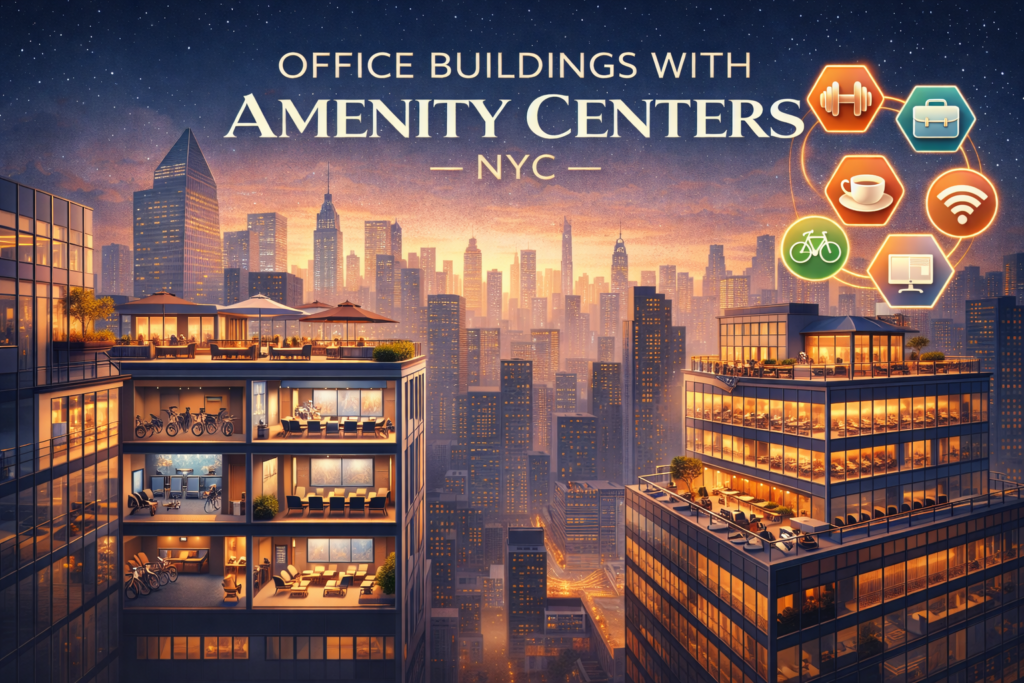
Office buildings with amenity centers in NYC represent a structural shift in how Manhattan office towers compete for tenants. Historically, the building itself was the product. Today, however, the amenity ecosystem surrounding the office floor has become just as important as the space inside the suite.
In modern Manhattan leasing, large amenity centers act as shared infrastructure across the building. They expand the functional footprint of an office without requiring tenants to lease additional square footage. Consequently, companies can operate in smaller suites while still accessing large meeting venues, wellness facilities, hospitality spaces, and collaborative environments.
This page explains how amenity center buildings function operationally, which tenants benefit from them, and when the perceived value of these environments may or may not justify the rent premium associated with them.
What Is an Amenity Center in a Manhattan Office Building
An amenity center is a dedicated collection of shared spaces within a building designed to support tenant operations, employee experience, and client hospitality.
Unlike individual office amenities contained within a tenant suite, amenity centers are centralized and shared across the building’s tenant roster.
Common features include:
• Hospitality-style tenant lounges
• Shared conference centers with reservable meeting rooms
• Fitness clubs and wellness facilities
• Tenant cafés or dining halls
• Rooftop terraces and outdoor gathering areas
• Event spaces for corporate functions
• Locker rooms and shower facilities
• Bicycle storage rooms
• Quiet work lounges and phone rooms
• Podcast or media recording studios
Because these amenities operate as building-wide resources, they allow tenants to avoid constructing these functions inside their own offices.
As a result, the office floor becomes more efficient.
Why Amenity Centers Became a Major Leasing Strategy
Amenity centers emerged as a response to two forces shaping the Manhattan office market.
First, tenants increasingly expect hospitality-style workplace environments. Employers compete for talent, and workplace experience has become a recruiting and retention tool.
Second, landlords recognized that amenity packages allow buildings to differentiate themselves beyond location alone.
As a result, large landlords began building entire amenity platforms spanning multiple floors.
These environments often function almost like private clubs for building tenants, offering spaces for meetings, events, social interaction, and wellness activities.
Notably, this model allows landlords to increase building competitiveness without expanding rentable square footage.
Major NYC Buildings Known for Amenity Center Ecosystems
Several Manhattan office complexes have pioneered the large-scale amenity center model.
These developments treat amenities as core building infrastructure rather than optional features.
Examples include:
Hudson Yards
Hudson Yards
Hudson Yards introduced one of the largest amenity ecosystems in the Manhattan office market.
Tenants gain access to:
• shared conference centers
• fitness and wellness clubs
• large-scale tenant lounges
• dining halls and hospitality spaces
• outdoor terraces
• event venues
Consequently, many companies operating there maintain smaller internal offices because the building itself supplies additional work environments.
Manhattan West
Manhattan West
Manhattan West integrates amenity centers directly into its office towers. The complex features hospitality-style lounges, reservable conference facilities, wellness spaces, and tenant-only gathering environments.
In practice, these amenities function as shared extensions of the tenant workspace.
One Vanderbilt
One Vanderbilt
One Vanderbilt introduced a modern amenity concept focused on tenant hospitality and event programming.
The building includes tenant lounges, meeting venues, and collaborative spaces designed to support companies that frequently host clients.
Because of its location near Grand Central, the building also combines transit connectivity with high-end tenant services.
Brookfield Place
Brookfield Place
Brookfield Place represents one of the earliest examples of large-scale tenant amenity integration in Lower Manhattan.
The complex combines office towers with dining halls, event spaces, waterfront terraces, and retail environments that function as everyday amenities for office tenants.

How Amenity Centers Change Office Layout Decisions
Amenity centers influence how companies design their internal office layouts.
Traditionally, tenants built large conference rooms, lounges, and social spaces within their suites.
However, when a building provides these functions centrally, tenants can reallocate that square footage toward operational workspace.
Examples of layout shifts include:
• Fewer oversized conference rooms
• Smaller internal lounge areas
• Reduced kitchen footprints
• More efficient workstation density
As a result, tenants may lease less square footage overall while maintaining the same functional capacity.
When Amenity Buildings Make Strategic Sense
Office buildings with large amenity centers tend to work best for certain types of tenants.
These environments benefit organizations that:
• host clients frequently
• operate hybrid work schedules
• require flexible meeting environments
• value hospitality-style workspaces
• want social and wellness programming available to employees
Technology firms, media companies, financial services firms, and professional services companies often benefit most from these environments.
In these cases, the amenity ecosystem becomes an extension of the workplace.
When Amenity Centers Can Be Overvalued
However, amenity centers are not universally beneficial.
In some cases, companies pay rent premiums for features they rarely use.
Examples include:
• organizations with minimal in-person staff
• firms operating mostly private offices
• companies with strict confidentiality requirements
• businesses that rarely host external guests
In these situations, tenants may be better served by simpler buildings with efficient office layouts and lower rents.
Therefore, evaluating how frequently employees will actually use these amenities becomes essential.
Amenity Centers and the Future of Manhattan Offices
Amenity centers are likely to remain a defining feature of new office developments in Manhattan.
As hybrid work patterns continue evolving, buildings must offer more than just square footage.
They must provide environments that support collaboration, hospitality, and flexibility.
Consequently, many new developments now dedicate entire floors to tenant amenities.
This shift reflects a broader change in how companies evaluate office space: the building is no longer just where work happens. It is part of the workplace experience itself.
Summary
Office buildings with amenity centers in NYC represent a major shift in how Manhattan office space functions.
Rather than forcing tenants to build every feature inside their suite, modern buildings provide shared hospitality environments, meeting facilities, wellness spaces, and collaborative areas.
When used effectively, these amenities allow companies to operate more efficiently while improving employee experience.
However, tenants must evaluate whether they will truly use these features. If not, the rent premium associated with high-end amenity ecosystems may outweigh the operational benefit.
Understanding how amenity centers function within the building helps companies determine whether these environments are a strategic advantage or simply a marketing feature.
Fill out our 📋 online form or give us a call today 📞 212-967-2061 — let’s find the right office for your business.
Additional NYC Office Buildings With Amenity Centers
While major developments like Hudson Yards and Manhattan West helped popularize the modern amenity ecosystem concept, numerous other Manhattan office buildings have adopted large-scale amenity center strategies as well. These buildings often appear in search results for “office buildings with amenities NYC” because they provide centralized facilities that extend beyond the tenant suite.
The buildings below frequently surface in market discussions and search results when tenants evaluate shared building infrastructure such as wellness facilities, event spaces, rooftop terraces, and collaborative environments.
10 Hudson Yards
10 Hudson Yards is one of the early office towers within the Hudson Yards district and helped introduce the concept of a hospitality-driven tenant environment in Midtown West.
The building’s amenity ecosystem includes tenant gathering areas, hospitality venues, and shared meeting environments designed to support companies hosting clients or internal events. Because Hudson Yards functions as a larger mixed-use district, the building’s amenity ecosystem also extends into nearby restaurants, retail environments, and outdoor plazas that function as informal work and meeting spaces.
For tenants, this creates a workplace environment where building amenities and neighborhood infrastructure blend together, effectively expanding the functional footprint of the office.
3 World Trade Center — 175 Greenwich Street
3 World Trade Center is widely recognized for its modern amenity platform designed to support collaboration, meetings, and tenant interaction.
Key amenity elements include:
• shared meeting environments
• collaborative lounges
• tenant event spaces
• hospitality-oriented gathering areas
The building’s position within the World Trade Center campus also allows tenants to access a broader ecosystem that includes retail, restaurants, and transit connections.
Because of this integrated environment, many companies operating at 3 World Trade Center maintain leaner internal office layouts, relying on building infrastructure to host larger meetings and gatherings.
One World Trade Center — 285 Fulton Street
One World Trade Center features a large tenant amenity center that includes conference facilities, collaborative lounges, and wellness-focused environments.
One of the most notable aspects of the building is the One World Commons tenant amenity center, a shared facility designed to function as a central hub for tenant interaction and meetings.
Features commonly associated with this amenity center include:
• conference rooms and event venues
• lounge seating environments
• collaboration areas
• wellness and fitness programming
Because the building sits at the center of Lower Manhattan’s transportation network, the amenity ecosystem is further reinforced by access to retail, transit, and hospitality services within the broader World Trade Center complex.
1250 Broadway — The Playground Amenity Center
1250 Broadway is frequently mentioned in discussions of Midtown amenity centers because it introduced “The Playground,” a shared tenant amenity facility designed to create a social workplace environment.
The Playground includes a range of recreational and collaborative environments such as:
• gaming areas
• meeting lounges
• event space
• casual gathering areas
This concept reflects a broader shift in Manhattan office design where buildings offer social infrastructure intended to support company culture and informal collaboration.
140 Broadway — Financial District Amenity Hub
140 Broadway has implemented tenant-focused amenity upgrades designed to modernize the building’s workplace environment.
These upgrades include shared lounge spaces, meeting environments, and hospitality-oriented areas intended to provide tenants with flexible spaces for informal meetings and internal gatherings.
Because the building is located in the Financial District, its amenity program also benefits from proximity to outdoor plazas and retail environments that extend the workplace experience beyond the building interior.
450 Park Avenue — Wellness-Focused Amenity Environment
450 Park Avenue is often referenced in discussions of wellness-oriented office amenities in Midtown.
The building incorporates features such as:
• wellness facilities
• fitness environments
• relaxation areas
• meeting lounges
This reflects a broader trend in modern Manhattan office buildings where employee wellness and workplace comfort have become part of the building’s competitive positioning.
The Seagram Building — 375 Park Avenue
Although known historically for its architectural significance, the Seagram Building has also evolved to incorporate modern tenant services that align with contemporary workplace expectations.
Tenant amenities focus on hospitality and meeting infrastructure, ensuring that the building remains competitive with newer developments that emphasize shared environments and tenant experience.
Typical Amenities Found in NYC Amenity Center Buildings
Across Manhattan, buildings that advertise amenity centers generally provide a similar group of shared facilities. While the exact features vary by building, the most common components include:
Wellness and fitness facilities
Many amenity center buildings include:
• full fitness centers
• yoga or meditation studios
• locker rooms and showers
• wellness treatment rooms
These facilities allow employees to incorporate exercise into their daily routine without leaving the building.
Outdoor spaces and rooftop terraces
Outdoor environments have become one of the most sought-after amenities in Manhattan office buildings.
These may include:
• landscaped rooftop terraces
• outdoor seating areas
• event terraces
• garden environments
In dense urban environments, these outdoor areas provide employees with access to fresh air and informal meeting spaces.
Conference centers and meeting suites
Many amenity centers include shared meeting facilities that allow tenants to host larger meetings without dedicating significant space inside their offices.
These spaces may include:
• boardrooms
• training rooms
• event venues
• presentation spaces
For tenants, this means internal offices can focus primarily on operational workspaces rather than hosting large gatherings.
Recreation and social areas
Some amenity centers incorporate recreational elements designed to support workplace culture and collaboration.
Examples may include:
• gaming lounges
• table tennis or billiards
• casual seating areas
• event and networking spaces
These spaces allow employees to interact informally and can also be used for company events.
Outdoor Amenity Environments in Manhattan Office Buildings
Another growing category within the amenity ecosystem is outdoor workplace infrastructure.
Several Manhattan developments now include large outdoor environments such as:
• rooftop gardens
• landscaped plazas
• outdoor meeting areas
• waterfront terraces
Buildings such as those in Hudson Yards, the World Trade Center complex, and Essex Crossing have incorporated outdoor space into their tenant amenity programs because outdoor environments support employee wellbeing and provide additional informal meeting locations.
How Amenity Centers Affect Leasing Decisions
For many organizations, access to a building’s amenity center influences office layout strategy and real estate costs.
When a building provides centralized meeting rooms, event space, and wellness facilities, tenants can reduce the amount of space they must dedicate to these functions within their own offices.
This can lead to:
• smaller internal conference rooms
• fewer dedicated event areas
• reduced lounge space inside the office
In effect, the building itself becomes an extension of the workplace.
This model has become particularly relevant as hybrid work patterns increase the need for flexible gathering environments rather than fixed office infrastructure.
What Tenants Should Evaluate When Touring Amenity Center Buildings
Not all amenity centers function the same way operationally. When evaluating buildings with amenity centers, tenants should ask several practical questions.
Important considerations include:
• whether amenity access is included in rent
• reservation policies for conference spaces
• hours of operation for fitness facilities
• guest access policies
• availability during peak times
These operational factors determine whether the amenity center will actually support the company’s workflow.
Why Amenity Centers Continue Expanding in NYC Office Development
Amenity centers have become a defining feature of new office developments because landlords increasingly compete on tenant experience rather than just location.
Modern tenants expect office environments that support:
• collaboration
• employee wellness
• social interaction
• client hosting
Because of this, many new developments dedicate entire floors to amenity programming, treating these spaces as critical infrastructure rather than optional perks.
The Role of Amenity Centers in the Future of Office Leasing
As Manhattan’s office market evolves, amenity centers are likely to remain a central component of building design.
Rather than functioning as marketing features, these environments increasingly serve as operational infrastructure supporting how modern organizations work.
For tenants, this means evaluating not only the office space itself but also the shared building environments that extend the workplace beyond the leased suite.
When implemented effectively, amenity centers can allow companies to operate more efficiently, improve employee experience, and create workplaces that adapt more easily to changing work patterns.