Best Office Layout for Tech Team: Designing AI-Focused Workspaces in Manhattan
AI-focused teams in Manhattan need a very specific kind of office environment—one that supports fast collaboration, deep technical concentration, seamless hybrid participation, and high-performance equipment setups. Traditional open plans fall short, while fully enclosed layouts slow innovation. The modern AI workplace must balance collective problem-solving zones with private, heads-down quiet areas, giving engineers, data scientists, and product teams the right environment for each stage of their workflow. This guide explains how to design the best office layout for tech team operations in New York City, offering practical configurations that support productivity, ergonomics, and tenant advantage in today’s AI-centered workplace.
AI Teams Work Differently—And So Should Their Office Layout
AI-driven roles require both deep, distraction-free concentration and intense bursts of in-person collaboration. Engineers cycle between coding sprints, whiteboard sessions, stand-up meetings, infrastructure reviews, and debugging marathons. Because these workflows vary hour to hour, AI teams thrive in flexible layouts that adapt to their rhythm rather than confine them to rigid desks or static open areas.
Unlike traditional corporate offices, where one layout served all departments, AI-era offices must respect:
- noise sensitivity
- equipment needs
- hybrid attendance
- confidentiality
- rapid prototyping cycles
This creates a blend of zones that support both individual and collective work styles—and help Manhattan tenants maximize performance while eliminating wasted square footage.
Collaboration Zones: Where AI Teams Accelerate Breakthroughs
Collaboration areas serve as the engine room for AI development. These zones anchor the layout and allow teams to solve problems faster, iterate on models, and review output together.
1. Whiteboard Walls & Brainstorming Corners
AI workflows depend heavily on sketching out architectures, model flows, and problem branches. Floor-to-ceiling whiteboard walls help teams visualize and resolve issues in real time.
2. Modular Team Tables
Movable tables with integrated power and monitor mounts allow rapid reconfiguration for:
- sprint planning
- model review sessions
- pair programming
- cross-team syncs
They give engineering groups the ability to adjust the space to the task, not the other way around.
3. Huddle Rooms
Small, glass-front rooms support 3–6 people for daily stand-ups, code reviews, and system architecture discussions. These rooms replace traditional oversized conference rooms and improve utilization.
4. Large Format Collaboration Screens
AI teams rely on visual output—charts, embeddings, dashboards, code comparisons. High-resolution displays facilitate shared review and reduce meeting friction.
5. Hybrid-Ready Conference Rooms
Modern AI teams collaborate with remote colleagues, offshore developers, and distributed data scientists. Conference rooms must include:
- acoustic treatment
- wall-mounted cameras
- beamforming microphones
- multi-screen setups
These features ensure remote participants see diagrams and screens clearly, and that hybrid meetings don’t slow momentum.
Quiet Zones: Where Engineers Focus and Deliver
AI development requires long periods of uninterrupted concentration. Quiet zones give engineers a place to dive deep into model tuning, debugging, or coding without distraction.
1. Soundproof Pods
Individual pods provide concentrated privacy for:
- complex coding
- performance optimization
- debugging
- sensitive model work
Pods eliminate noise without consuming excessive square footage.
2. Focus Rooms
Slightly larger than pods, these rooms support engineers who need several hours of quiet work with:
- dual monitors
- ergonomic chairs
- dimmable lighting
- sound dampening
They prevent the burnout that often comes from noisy bullpen environments.
3. Low-Traffic Workstation Rows
AI teams still need dedicated desks for engineers who attend regularly. These rows should be placed away from:
- reception
- meeting rooms
- collaboration areas
- pantry activity
The goal is minimal foot traffic and consistent quiet.
4. Deep-Work Zones with Desk Sharing
Because hybrid schedules reduce attendance, tenants can implement desk-sharing in quiet zones without sacrificing productivity—as long as seats are ergonomic and tech-ready.
Balancing Collaboration and Quiet Areas: The Core of AI Office Strategy
The best office layout for tech team operations blends these zones in proportions unique to each organization. However, certain principles apply universally for AI-focused Manhattan tenants:
1. Separate Noisy and Quiet Functions
Collaboration zones should be intentionally distanced from heads-down areas so noise does not bleed into concentration work.
2. Use Glass Walls for Visibility Without Disruption
Visibility supports teamwork; acoustic separation supports focus. Glass achieves both.
3. Place Meeting Rooms on Column Lines
This makes workstation areas more open and maximizes natural light for engineers, improving ergonomics and morale.
4. Keep Collaborative Spaces Central
AI teams often move between quiet focus work and rapid group problem-solving. Central placement shortens the distance between zones.
5. Put Quiet Zones in Corners or Along Windowed Perimeters
Engineers benefit from natural light and minimal noise—corner areas are ideal.
6. Build an Internal “Tech Spine”
AI teams depend on seamless connectivity. A tech spine includes:
- server racks
- equipment closets
- redundant cabling
- patch panels
- IT staging areas
These should be centrally located, not buried in awkward back rooms.
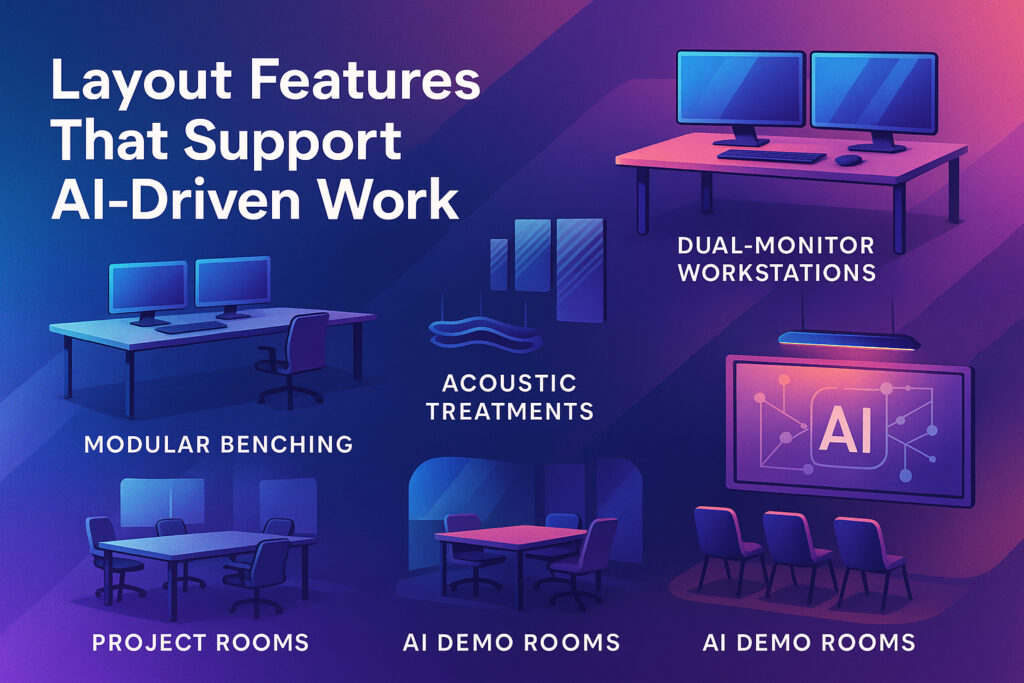
Layout Features That Support AI-Driven Work
Modular Benching
Ideal for teams that shift between solo and pair programming.
Dual-Monitor Workstations
Critical for complex model tuning, code review, and multi-window workflows.
Acoustic Treatments
Panels, carpets, and suspended sound baffles dramatically improve productivity in hybrid offices.
Project Rooms
Dedicated rooms for long-term experiments or ongoing model development reduce disruptions.
AI Demo Rooms
Sales-engineering teams often need customer demo areas—an important consideration for image-conscious Manhattan tenants.
Where Manhattan Tenants Gain the Most Advantage
AI-focused office layouts allow tenants to use space more efficiently while improving team performance. When Manhattan companies combine collaboration and quiet zones correctly, they gain:
- lower overall square footage requirements
- improved staff output and retention
- stronger client-facing impressions
- better use of loss-factor-impacted areas
- justification to move into higher-class buildings
- the ability to choose prebuilt suites that already support hybrid and technical use
AI-era tech teams do not need massive rows of desks—they need purpose-built rooms that support the natural cycle of engineering and model development.
When to Redesign Your Space
Tenants should reconsider layout design when:
- adopting new AI workflows
- hiring more engineers or data scientists
- shifting to hybrid scheduling
- renewing a lease
- upgrading buildings or relocating
- consolidating after automation reduces admin roles
Lease events are the ideal moment to negotiate build-out allowances, furniture packages, or landlord-funded modifications.
Conclusion
Designing the best office layout for tech team work in Manhattan means blending collaboration hubs with quiet, high-performance focus zones. AI-driven companies must create environments where software engineers, data scientists, ML researchers, and product teams can move seamlessly between teamwork and deep work. The right layout reduces wasted rent, improves ergonomics, elevates image, and supports the high-speed cycles of modern AI development.
Every AI team is different, and a custom layout analysis ensures your space reflects the real workflows of your staff. As tenant-only representatives, we help NYC businesses evaluate buildings, diagnose layout requirements, and negotiate the terms needed to build high-performance workspaces that support modern AI operations. When you’re ready to plan a space that truly aligns with how your team works, we can guide your search and execution from start to finish.
Fill out our 📋 online form or give us a call today 📞 212-967-2061 — let’s find the right options for your business.